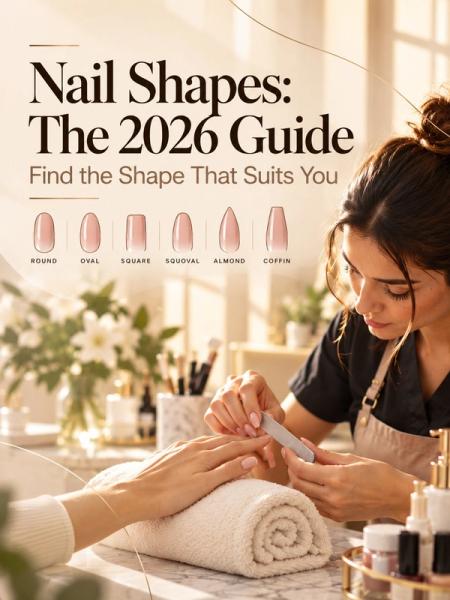
Nail Shapes: The 2026 Chart to Every Shape and Which Suits You

Ever sat in the salon chair, got asked "so, what shape today?" and just... froze? Round, square, almond, coffin, that one your friend has that looks like a tiny claw. They all sound great until you have to pick one for your own hands.
Here's the thing most guides skip: the "best" nail shape isn't the trendiest one. It's the one that flatters your fingers, survives your daily life, and actually grows out well on your nails. Get that match right and your hands look longer, slimmer, and more put-together. Get it wrong and even a flawless polish job falls flat.
This guide covers all 12 nail shapes, how each one is filed, who it suits best, and how to pick yours with confidence. There's a quick-scan chart below if you just want the reference, then a full breakdown of every shape. We teach this exact framework to students training as nail technicians, so you're getting the version that works in a real salon, not just a Pinterest board.
Why Your Nail Shape Actually Matters
Nail shape does three jobs at once. It changes how your hands look, how your manicure lasts, and how much upkeep you sign up for.
A tapered shape like almond or oval creates the illusion of length and makes fingers look more slender. A flat, sturdy shape like square or squoval resists breakage and is the practical pick if you type all day or work with your hands. And some shapes, stiletto and coffin especially, look stunning but demand length, strength, and regular maintenance to stay sharp.
So before you chase a trend, it helps to know what each shape is really asking of you.
The Anatomy Behind a Good Shape
Every shape is filed in relation to three things on your nail: the free edge (the white part you file), the sidewalls (the straight edges running up each side), and the nail bed (the pink part attached to your finger).
A skilled shape works with your natural sidewalls instead of fighting them, which is why the same shape can look elegant on one person and awkward on another. Keep that in mind as you read, your natural nail is the starting point, not the enemy.
Proper Nail Structure: Foundations Behind Every Shape
Before you fall in love with a silhouette, the structure underneath has to be right. These are the building rules that apply to every nail shape — center line, sidewalls, zones, apex, and free-edge angle. Get these wrong and even a trendy shape will look off and break early.
Center Line
The center line runs straight down the middle of the nail from cuticle to free edge, ideally lining up with the knuckle. File evenly on both sides of it or the finished shape looks twisted.

Sidewall Guidelines
Sidewalls should stay straight and parallel from cuticle to free edge for most shapes. Over-filing makes nails too skinny, damages the bed, and throws free-edge shaping off — whether you're finishing square, squoval, almond, or round.

Building Zones
Every enhancement has three zones: a thin flush cuticle area, a thicker apex/stress area for strength, and a medium free edge that supports length without bulk.

Apex / Stress Point
Correct apex placement sits around one-third down the nail bed, near the natural free edge. Too far forward or too far back removes the strength the nail needs.

Free Edge Angle
Whether you use forms or tips, product should leave the sides of the free edge straight. An angled application leaves extensions pointing up or down and weakens the whole shape.

The Nail Shapes Chart (Quick Reference)
Here's every shape at a glance. Scan it, find your match, then read the full breakdown below for how each one is filed.
- Round — Best for: Short nails, wide beds. Maintenance: Low. Style vibe: Natural, understated.
- Oval — Best for: Short fingers, most hands. Maintenance: Low–Medium. Style vibe: Elegant, timeless.
- Square — Best for: Long fingers, narrow beds. Maintenance: Medium. Style vibe: Bold, modern.
- Squoval — Best for: Almost anyone. Maintenance: Low–Medium. Style vibe: Clean, versatile.
- Rounded Square — Best for: Narrow beds, soft modern look. Maintenance: Medium. Style vibe: Polished, everyday.
- Almond — Best for: Wide/short beds, longer nails. Maintenance: Medium–High. Style vibe: Chic, feminine.
- Oval-Pointed (Mountain Peak) — Best for: Slender hands, statement look. Maintenance: High. Style vibe: Sleek, dramatic.
- Coffin (Ballerina) — Best for: Long nails, acrylics. Maintenance: High. Style vibe: Trendy, art-ready.
- Stiletto — Best for: Long thin fingers, acrylics. Maintenance: High. Style vibe: Fierce, bold.
- Lipstick — Best for: Fashion-forward, short-medium. Maintenance: Medium. Style vibe: Edgy, unique.
- Flare (Duck) — Best for: Statement nail art. Maintenance: High. Style vibe: Retro, eye-catching.
- Arrowhead — Best for: Extreme statement looks. Maintenance: High. Style vibe: Sharp, avant-garde.
Every Nail Shape, Explained
Round
The round nail is the classic, low-key, no-drama choice. The free edge follows the natural curve of your fingertip in a smooth semicircle.
Best for: Short nails, wide nail beds, anyone who wants a clean look with zero fuss. It's the most natural-looking shape and the easiest to maintain.
How it's filed: Follow the natural curve of the fingertip, filing the edge into a soft arc that mirrors your cuticle line.
Upkeep: Low. Round nails grow out gracefully and rarely snag.
Oval
Think of oval as round's more elegant sibling. It tapers gently on both sides and rounds off at the tip, creating an egg-like silhouette.
Best for: Short fingers and wide nail beds. The taper visually lengthens and slims the hand, which is why oval flatters almost everyone.
How it's filed: File each sidewall inward, curving slightly toward the center at the tip to create that soft, symmetrical point.
Upkeep: Low to medium. Needs a little sidewall filing to keep the taper clean.
Square
Straight sidewalls, a flat top, and crisp 90-degree corners. Square is bold, modern, and the natural home of a sharp French tip.
Best for: Long fingers and narrow nail beds, where the width balances the hand. A staple for anyone who loves a structured, graphic look.
How it's filed: File the free edge straight across, then keep the corners sharp and square rather than rounding them.
Upkeep: Medium. Those sharp corners can catch and chip if your natural nails are brittle.
Square is also the classic home of a crisp French tip. When you build a French extension, the reverse ledge and smile line have to stay even at the center line and reach sidewall to sidewall.

Squoval
The crowd-pleaser. Square's straight edges with the corners softened off, so you get structure without the snag risk.
Best for: Almost anyone. It's durable, flattering, and works beautifully on both natural nails and extensions. If you can't decide, this is the safe, smart default.
How it's filed: File straight across like a square, then gently round off each corner in one smooth stroke.
Upkeep: Low to medium, and one of the strongest everyday shapes.
Almond
Slim sides that taper up to a soft, rounded point, like the nut it's named after. Almond is feminine, elegant, and a social-media favorite.
Best for: Longer nails or acrylics, and especially wide or short nail beds, because the taper creates length and slims the finger.
How it's filed: File both sidewalls inward at a steeper angle than oval, meeting in a rounded (not sharp) peak at the tip.
Upkeep: Medium to high. Needs length and strength to hold the point, so it suits enhancements or naturally strong nails.
Coffin (Ballerina)
Picture the taper of almond with the tip sliced flat, like a coffin or a ballerina's slipper. Dramatic, trendy, and made for nail art.
Best for: Long nails and acrylics. Narrow and wide beds both work if you have the length to carry it.
How it's filed: Taper the sidewalls inward like almond, then file the tip flat straight across instead of to a point.
Upkeep: High. Coffin needs length and regular fills to keep the flat tip and tapered sides sharp.
Stiletto
The showstopper. Sidewalls taper dramatically to a single sharp point. Stiletto is pure statement, long, fierce, and impossible to ignore.
Best for: Long, thin fingers and anyone who treats their nails as an accessory. Almost always done on acrylics or hard gel for strength.
How it's filed: File both sides in a long, aggressive taper to a sharp central point, keeping both sides perfectly symmetrical.
Upkeep: High. The point is fragile and needs enhancements plus frequent maintenance.
Rounded Square
Exactly what it sounds like: a square shape with the sharp corners just barely softened. It keeps the structured, modern look of square but loses the snag-and-chip risk of those hard 90-degree corners.
Best for: Narrow nail beds and anyone who loves the square look but wants it a little more wearable. Flatters most hands.
How it's filed: File straight across like a square, then lightly round only the very corners, less than you would for a squoval.
Upkeep: Medium. Sturdier than a true square, cleaner than a squoval.
Oval-Pointed (Mountain Peak)
A sleek, elongated shape that tapers to a soft point higher than almond, with a subtle ridge running to the tip. It reads as dramatic without going full stiletto.
Best for: Slender hands and anyone wanting a statement shape that still looks refined. Usually done with some length.
How it's filed: Taper both sidewalls inward toward a high, soft point, keeping the centre line straight and symmetrical.
Upkeep: High. The point needs length and strength to hold.
Lipstick
An angled, slanted tip cut on the diagonal, like the fresh bullet of a brand-new lipstick. It's one of the most fashion-forward, unexpected shapes out there.
Best for: Short to medium lengths and anyone who wants something genuinely different. A favorite for editorial and nail-art looks.
How it's filed: File the free edge at a slant across the tip rather than straight or curved, keeping the angle consistent on every nail.
Upkeep: Medium. The slant needs re-filing as the nail grows to keep the angle sharp.
Flare (Duck)
A retro, eye-catching shape where the nail widens at the tip instead of staying straight or tapering, creating a fan or "duck foot" silhouette. Bold, playful, and made for maximalist nail art.
Best for: Statement looks and heavy nail art, almost always on extensions. Not an everyday shape.
How it's filed: Built out with forms or tips so the free edge flares wider than the nail bed, then shaped flat or rounded at the tip.
Upkeep: High. Needs extensions and regular fills.
Arrowhead
The most extreme statement shape: sharper and more angular than stiletto, filed to a narrow, aggressive point like an arrow tip. Pure avant-garde.
Best for: Editorial, costume, and bold creative looks. Rarely an everyday choice.
How it's filed: Taper both sides in a steep, straight line to an extremely sharp central point, done on strong acrylics or hard gel.
Upkeep: High. Fragile point, frequent maintenance, extensions required.
How to Choose the Right Nail Shape for Your Hands
Here's the simple framework we teach. Run through these four questions and your answer gets obvious fast.
1. Look at your nail beds
Wide nail beds: Tapered shapes (almond, oval, rounded square) slim the look. Avoid very round shapes that emphasize width.
Narrow nail beds: Square or squoval fill out the finger nicely. Skinny tapers can look spindly.
Short nail beds: Oval and almond create the illusion of length. Steer clear of blunt square, which can look stubby.
2. Check your finger length
Shorter fingers look longer with oval, almond, or any tapered tip. Long fingers can carry bolder shapes like square or stiletto without looking overpowering.
3. Be honest about your lifestyle
If you type, lift, cook, or chase kids all day, your nails take a beating. Round and squoval are the durable, snag-resistant workhorses. Save stiletto and coffin for when you've got the time (and length) to maintain them.
4. Decide how much upkeep you want
Low-maintenance? Round, oval, squoval. Happy to book regular fills? The whole dramatic end of the spectrum opens up.
Quick Match: Find Your Shape in One Line
- Want the easiest, most natural look: Round
- Want flattering and elegant with little fuss: Oval
- Love a bold, structured French tip: Square
- Can't decide and want durability: Squoval
- Want length and a chic taper: Almond
- Into trends and nail art: Coffin
- Want maximum drama: Stiletto
Nail Shape and Nail Health: The Part Most Guides Miss
Structure also changes between appointments. At a fill, the apex has grown forward with the natural nail and needs to be rebuilt — especially if growth is pointing downward below the sidewall line.

A beautiful shape on a damaged nail never looks right, and this is where professional training shows. Filing in one direction rather than sawing back and forth prevents splitting, a point dermatologists at the American Academy of Dermatology echo in their nail-care guidance. Sealing the free edge protects against peeling. And choosing a shape your natural nail can actually support, instead of forcing a stiletto onto a weak, flexible nail, is the difference between a manicure that lasts two weeks and one that chips in two days.
This is exactly the kind of foundational skill covered in a professional nail technician course: not just what the shapes are, but how to file them cleanly, match them to a client's hands, and keep the natural nail healthy underneath. If you've ever thought about turning a love of nails into a career, that knowledge is learnable, and it's in demand.
Frequently Asked Questions
What is the strongest nail shape?
Squoval and round are the strongest, most break-resistant shapes because they have no sharp corners or long tapered points to catch and snap. They're the best choice for natural nails and anyone hard on their hands.
What nail shape makes fingers look longer?
Oval, almond, and stiletto all elongate the finger. Their tapered sides and tips draw the eye upward and create the illusion of length, making them ideal for shorter fingers or wide nail beds.
What is the best nail shape for short nails?
Round and oval are the best shapes for short nails. They follow the natural fingertip, look clean without any length, and grow out gracefully without needing constant reshaping.
What's the difference between coffin and stiletto nails?
Both taper inward from the sides, but a stiletto files to a single sharp point while a coffin (ballerina) files the tip flat straight across. Coffin is slightly more wearable; stiletto is the bolder statement.
Which nail shape is easiest to maintain?
Round is the lowest-maintenance shape. It mirrors your natural fingertip, rarely snags, and grows out so evenly that it needs the least frequent reshaping of any shape.
Can I get any nail shape on my natural nails?
Not always. Short, dramatic shapes like round, oval, and squoval work on natural nails, but coffin, stiletto, and long almond usually need the length and strength of acrylics or hard gel to hold their form without breaking.
The Bottom Line
The best nail shape is the one that suits your hands, fits your life, and keeps your natural nails healthy, not just whatever's trending this month. Start with your nail bed and finger length, factor in how you use your hands, and you'll land on a shape that looks intentional and lasts.
And if reading this made you realize how much there actually is to nail shaping, the structure, the technique, the artistry, that's the craft real nail technicians train for. Learning it properly through an online nail technician course opens the door to a flexible, creative career in one of beauty's most in-demand skills. You can also explore all our beauty courses to see where nail training fits alongside esthetics and lash.
Written by the educators at Mirage Spa Education, Canada's online beauty and nail training provider. Our instructors are licensed nail technicians with 20+ years of hands-on and teaching experience, training students across Canada in professional nail, esthetics, and lash techniques.
Popular News